Mobile money
M Transactions
Mobile Phone Uptake is becoming a worldwide phenomenon
- Using Mobile Money transactions to deliver Economic Development is at work in under-developed countries of the world
Mobile on the Internet/World Wide Web
Smartphone Usage Statistics 2026
Over 5.78 billion people use smartphones.
More than 7.58 billion smartphones are in use.
Over 97% of users between 18 and 49 years old use smartphones.
Almost half of the people in the United States spend 5 to 6 hours on smartphones daily.
Smartphones make up 70% of digital media time in the United States.
M-commerce accounted for 60% of e-commerce.
Smartphone users touch their phones an average of 2,617 times daily in the United States.
Nearly 72% of teenagers check their phone messages and notifications after waking up.
See Statista
___________________________________________
On the Importance of 'Best Practices'
The Kenya - Africa Micropayments Model
Africa Mobile Statistics (Updated)
Africa dominates global mobile payments with over $1 trillion transactions– GSMA report
A new GSMA report confirms Africa’s leadership in mobile payments, with the continent accounting for 53% of global mobile money users last year and over $1 trillion in transactions. Contributing $190 billion to GDP, Africa’s mobile money ecosystem has evolved into a robust and mature digital payment infrastructure.
The State of the Industry Report on Mobile Money 2025 by GSMA confirms that Africa is an undisputed leader in digital payments, with the continent’s digital payments trends surpassing those of other regions in 2024...
The report also reveals that Africans are not simply holding accounts – they are actively transacting. The continent’s monthly active users are estimated at 283 million, more than half of the global total of 514 million.
In 2024 alone, $1.1 trillion of the global $1.68 trillion transacted through mobile money platforms was processed via African platforms.
What makes Africa’s success even more remarkable is the depth of its agent network. There are now 755 registered agents per 100,000 adults – double the ratio recorded in 2021.
This networking infrastructure ensures that even rural and underserved populations can access digital financial services...
🌎
More on Mobile in Africa
_______________________
A 2015 60 Minutes Report
The Kenya Mobile Money Story
Using mobiles to perform small tasks and transfer money can help blaze paths out of poverty...
_______________________
'Micropayments' Are Here
2025 Update / Africa
Mobile micropayments in Africa enable small, frequent transactions via mobile wallets and USSD codes, often without traditional bank accounts, and are a key driver of financial inclusion across the continent. The Africa mobile payments market was valued at USD 75.22 billion in 2025 and is projected to grow at a CAGR of 39.3% through 2034, with mobile money platforms expanding access to millions of users in countries like Kenya, Nigeria, Ghana, and Tanzania
The Mobile Money Revolution: Transforming Payments and Financial Access in Africa
Mobile interoperability across Africa, regulatory evolution, green finance integration, and adoption of emerging technologies

______________
Run the Numbers
70%
The truly personal computer
The smartphone is the defining technology of the age
There are 2 billion people around the world using smartphones that have an internet connection and a touchscreen or something similar as an interface. By the end of the decade that number looks set to double to just over 4 billion, according to Benedict Evans of Andreessen Horowitz. Already hugely attractive—an estimated 500m will be sold in China this year—smartphones are getting both more useful at the top end and much cheaper at the bottom....
Once phones are established in a market the expectation that everyone will have one - what Rich Ling of the Nanyang Technological University in Singapore calls the “mobile logic” — forces them even into initially reluctant hands, making them end up ubiquitous.... From 2009 to 2013 the mobile industry invested $1.8 trillion on improving its infrastructure around the world, according to the Boston Consulting Group. Download speeds have increased by a factor of 12,000 and data rates have dropped to a few cents per megabyte....
By 2020, something like 80% of adults will own a smartphone connected to this remarkable global resource. If they are anything like today’s Europeans and Americans, who are leading in these matters, they will use them for about two hours a day; if they are like today’s European and American teenagers they will use them more than that....
Thanks mostly to the iPhone, Apple—not so long ago a maker of niche desktops and laptops — is now worth more than any other company in the world and just had the most profitable quarter in history....
The smartphone has become information technology’s key product. It generates the most profits; it attracts the most capital.... As well as letting people do ever more on their phones, apps let them do ever more things off their phones, too. If something can be connected to the internet—be it a door or a fridge or a thermostat—it can be accessed by an app. The phone is thus central to the success of the “internet of things”. Wearable technology products — fitness trackers, smart watches, clip-on cameras and the like — will mostly work through the wearer’s phone in a similar way.... The new businesses that smartphones and apps allow are not merely extending the internet; they are also reshaping it....
When people access the internet with apps on a phone, rather than with a browser on a PC, they experience it differently. The internet looks a lot less like a set of connected pages, and that makes a business that depends on helping people find the page they want — and seeing ads in the process — look less compelling. Smartphone users mostly buy things through apps, not through searches or ads.... people are now finding stuff they want to read or watch through Facebook, Twitter and, increasingly, messaging services.... Recent political protests have taken advantage of the new fluidity. Smartphones have not caused uprisings or revolutions, but they have affected their dynamics.... sense of place has still mattered a lot to these movements—witness Kiev’s Maidan, Cairo’s Tahrir Square, New York’s Zuccotti Park, Hong Kong’s Civic Square.... Phone-based social media, messaging services and other apps already make people’s lives more public.... [via the Economist]
Mobile is eating the world -- Report from Andreessen Horowitz
Emerging Nations Embrace Mobile
Google Announces Under $100 Smartphone
Quarter of World will Use Smartphone by 2016
Global smartphone data to increase 8x by 2020

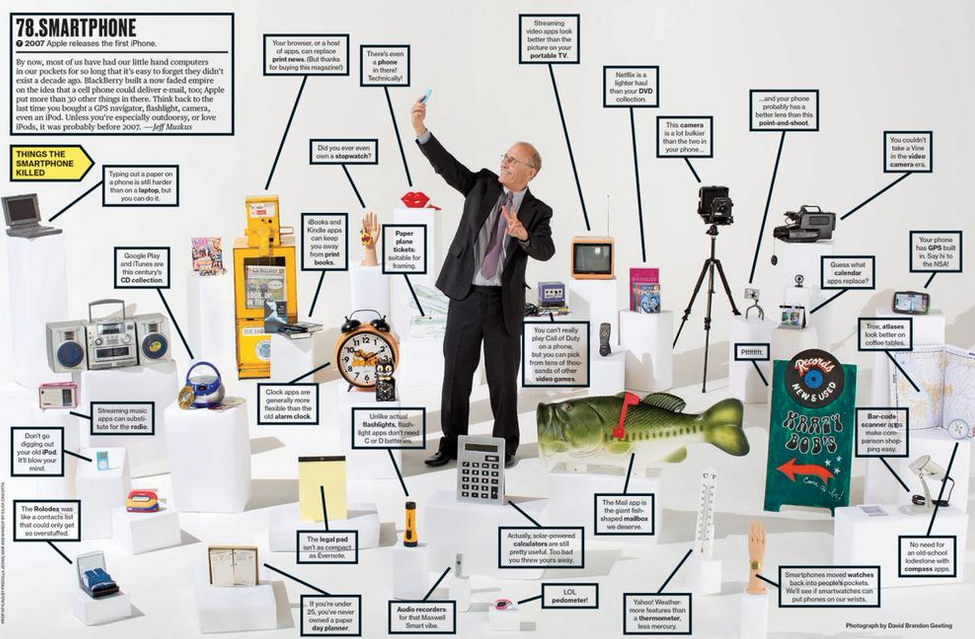
Where do the mobile numbers come from?

Bill Gates: how mobile banking can change the lives of the poor
Micropayment systems
Mobile Web
Mobile Wallets / Mobile Payments -- https://en.wikipedia.org/wiki/Mobile_payment
- Mobile for Development -- http://www.m4dimpact.com/
Mobile connectivity is enabling large parts of the world to come online for the first time. However, the creation and distribution of digital content remains deeply uneven. While nearly half of the world's population are now online (43%), entire languages, cultures and regions are absent or underrepresented...
The more users understand the digital world, the more likely they are to become engaged in creating content. Moreover, user education efforts need to evolve from being product and service-specific, to be being focused on broader notions of digital literacy...
Mozilla is a global community of technologists, thinkers and builders. Our mission is to promote openness, innovation and opportunity on the Web. Mozilla is the developer of free and open source products like Firefox and Firefox OS, as well as learning and leadership programs contributing to a more web literate world.
_____________________________


🌎